
Space governance you can step inside.
Read the launch brief →howdy [at] diplospace · orgSupport the work →
Diplo Space is a nonprofit lab. We turn contested space regimes into navigable 3D scenarios and crisis exercises: the rival U.S. and China–Russia rulebooks for the Moon, orbital debris, a GPS-denial crisis. Diplomats, congressional staff, and allied officials rehearse the decision before it’s real, with every claim tied to a primary source.
Space runs on rules most people never see: who may use which orbit, who answers for a piece of debris, whose signal has right of way, who gets which slice of spectrum. They live in treaties and UN documents.
71 nations (as of August 2026) have signed the Artemis Accords for the Moon; a China–Russia bloc is writing a competing rulebook for the same ground. Orbits fill with debris, spectrum fights sharpen, and GPS interference is now a daily feature of conflict zones.
The officials who must decide (diplomats, congressional staff, allied civil servants) are asked to act faster than they can understand a domain they can't see. We turn the regime into something they can walk through, and the decision into something they can rehearse.
One loop: a verified record underneath, a navigable explainer on top, an immersive scenario to rehearse in, and an after-action record you keep. Every piece runs in a plain browser.
A debris cascade and a GPS-denial event, walked through in three dimensions and rehearsed as a decision before it becomes a crisis. Fully remotable, so you don't have to fly everyone to one room; you leave with an after-action record.
The rival U.S. and China–Russia maps for the Moon; the Outer Space Treaty's stress points; the geography of a fight over who gets which slice of radio spectrum at the UN's telecom body. Each one turns a contested regime into something a non-specialist can see: every claim tied to treaty text or a UN document.
The open record of space-governance incidents and stress points the explainers and scenarios draw on: each entry dated, tied to a primary source, and built to still check out when your memo is read a year from now.
We build the scenes ourselves from primary data, bake them offline, and spend the real effort on the translation. Every scene on this site runs in a plain browser; the headset build adds rooms you can step inside, and is never a gate to what is here.
Plainly: the record is what happened, an explainer is what it means, a scenario is the decision rehearsed, and the after-action record is what you change. The problem was never too little information; it’s a domain officials can’t see. Everything here exists to make it navigable.
Three planning shorthands recur in this field: DIME for the instruments of national power, OODA for the tempo of a decision, ends-ways-means for strategy itself. Each is powerful. Each is a lens, not the whole picture.
Diplo Space is where they get used. Our scenarios drop you into a real space decision and let you bring whatever framework you already use, applied against the actual regime, the actual clock, and the actual trade-offs, not run as a checklist.
Built by an operator fluent in all of them: from strategy implementation at U.S. European Command, coordinating allied space work in theater, to navigation-warfare architecture at the FAA. Setting a strategy is hard; making it real is harder.
Try the 15-minute scenario →Atlas Spatial puts the whole Atlas on a tabletop in your room. Pinch an instrument and the room becomes the sky: the Station’s window seat over a sunlit limb, Artemis II rounding the far side as Earth rises, the Moon turned to the pole where two frameworks meet. A facilitator runs it from an iPhone.
Private beta, not on the App Store. Demonstrations for partners, funders, and pilot organizations.
See the six instruments →Request a demonstration →Founding partnerships from $50,000. The resulting public work remains independently governed and openly available.
 2009-02-10 · 16:55:59 UTC · contact
Every dot is a cataloged fragment of the 2009 Iridium–Cosmos collision, on its real orbit, from the public catalog. Scrub the replay and watch two orbits close, contact over Taymyr, and the debris spread into the band it still occupies.
Nobody broke a rule that day. That is the finding.
Open the instrument →Then make the call →Space-governance incidents and the policy moves around them: dated, tied to a primary source you can open, and citable in a memo.
50 never got past acknowledgement. Every entry is coded 0–4 for how far it actually travelled toward a coordinated response, against the primary source.
We built this for four kinds of official. If one of them is you, you should know where to start in about thirty seconds.
You've been handed a space-security portfolio with no engineering background. You need to see the regime and rehearse the decision, not read another report.
See an explainer →You're drafting language on orbital debris, PNT, or a treaty stress point. You want a neutral, citable, navigable picture you can defend line by line.
Open the record →You're building space literacy for a team or a delegation. You'd rather rehearse an orbital-crisis decision in 3D than sit through a lecture.
Step into a scenario →You back neutral public goods, and you check the EIN, the board, and the funding firewall first. It's all one click away.
See how we're built →The lab runs as small, time-boxed volunteer research cohorts, built around a credentialed, mobile, badly underused group: military spouses and Foreign Service family members. We offer the one thing the work usually can’t: a published byline that travels with you.
We’re new, and we won’t pretend otherwise. What we can give you on day one: every claim carries its source, the data is open and dated, the boundary is in writing, and the legal facts are one click away. The analysis and the judgment here are a person’s; where AI speeds the legwork, a human still opens every source and signs every claim. How we work is on the About page.
Diplo Space, Inc. is a Virginia 501(c)(3) public charity, EIN 99-1402470. No findings for sale, no positions taken, no foreign-government money.

17+ years in geospatial intelligence, satellite navigation and its disruption, and allied space planning: from strategy implementation at U.S. European Command to navigation-warfare architecture at the FAA. He runs the verification gate that clears every published claim, and serves unpaid.
Host a rehearsal, sponsor an explainer or a record increment, or just email a human and ask a question.

 01
01 02
02 03
03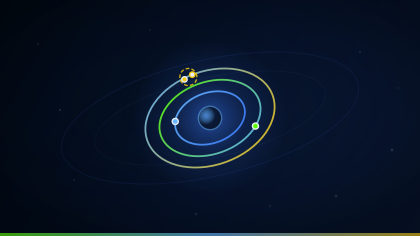 04
04