
Space governance you can step inside.
Read the launch brief →howdy [at] diplospace · orgSupport the work →
Two coalitions are writing the rules for the same lunar ground. Both say they're following the same 1967 treaty. This explainer maps who has signed what, and where they actually diverge. We render both sides and both readings; we don't tell you which is right.
71 signatory nations
Türkiye became the 71st on August 31, 2026, six weeks after Mauritius, the 70th. Official pace check: 13 nations signed in FY 2025 alone, reaching 59 by September 30, 2025 (Aeronautics and Space Report of the President, FY 2025).
Who: From the U.S., U.K., Japan, and most of Europe to India, Brazil, Nigeria, the UAE, and dozens more.
Affirms it operates under the 1967 Outer Space Treaty; treats space-resource extraction as consistent with the Treaty's non-appropriation rule, and uses notified “safety zones” to implement the Treaty's Article IX “due regard” principle and prevent harmful interference.
Source: NASA Artemis Accords; U.S. Department of State
~17 countries & organizations
Plus 50+ research institutions, per CNSA (April 2025).
Who: Including Azerbaijan, Belarus, Egypt, Pakistan, South Africa, Thailand, Venezuela, Kazakhstan, and Senegal.
An alternative framework for a lunar base: construction planned 2026–2035, operations from the 2030s. It positions itself as a coalition outside the Western-led Accords, while also grounding its cooperation in existing space law.
Source: CNSA; Secure World Foundation lunar-cooperation tracking
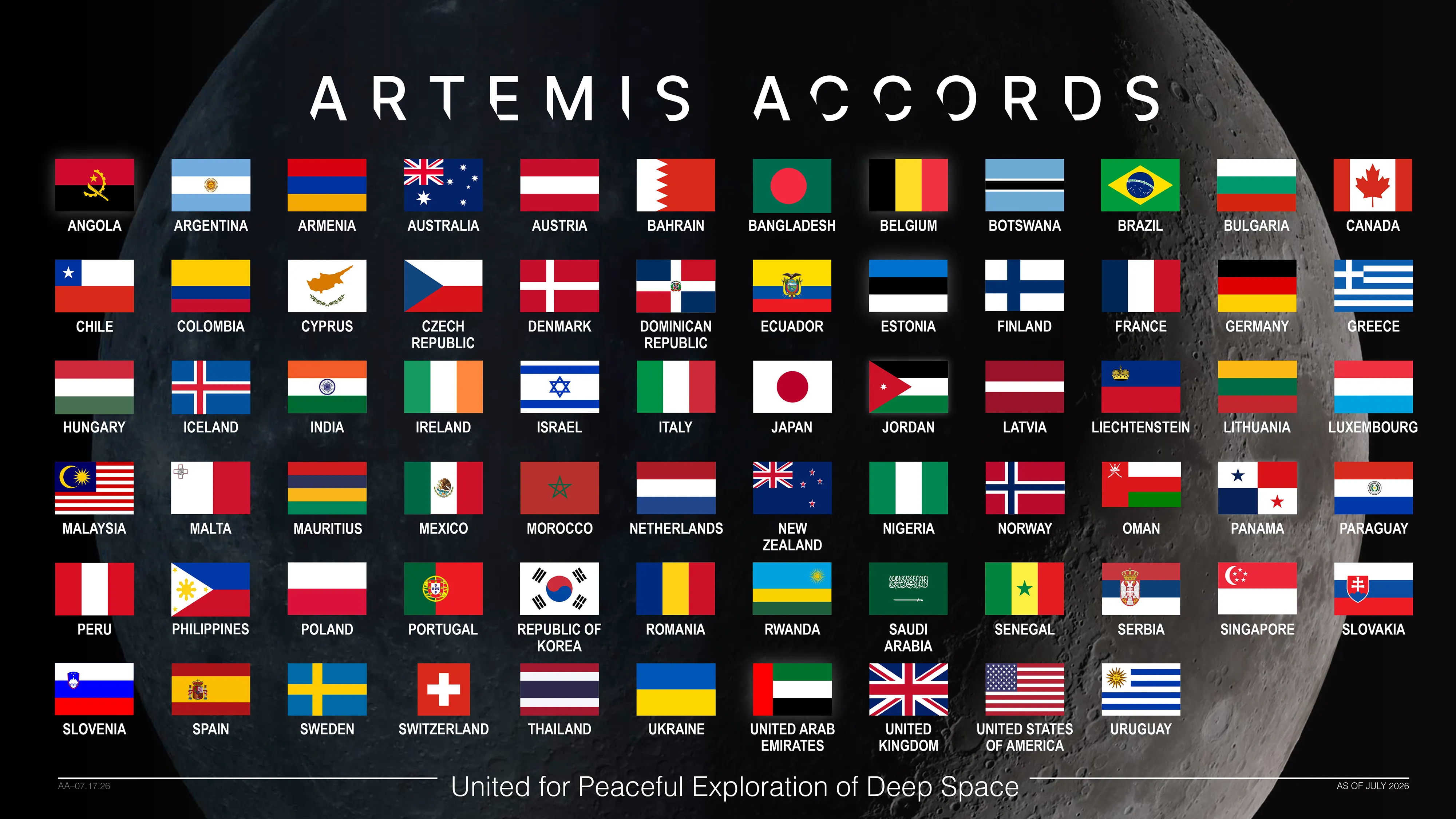
The 70 signatories as of July 2026; Türkiye became the 71st on August 31, 2026. Image: NASA, published with the Mauritius signing announcement ↗
Both blocs claim the same foundation: the 1967 Outer Space Treaty, which says space is for peaceful use, belongs to no nation (Article II), and that states bear international responsibility for their own national activities in space, including those carried on by private companies (Article VI). The split is not about whether the Treaty applies: it's about what it permits.
This is the part a non-specialist most needs: not who’s right, but exactly what’s being argued.
The two blocs aren't strictly exclusive: three states have signed both, Thailand in December 2024, Senegal in July 2025, and Serbia, an ILRS partner, which signed the Accords on 16 July 2026 (NASA; SpaceNews). Whether the Accords and the ILRS can ultimately be reconciled is, by most accounts, still an open question.
And beneath the rulebook fight sits a longer question: both coalitions are racing toward the same ground, and someone eventually has to live on it. That is the settlement question.
Counts current as of July 2026. Spot an error or a stale figure? Email a correction.